


MolTV: Crossing the Dimensional Divide—Transitional Visualizations of Molecules
Timeframe: 2026–2031

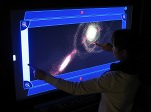
(AI-generated mock-up)
With MOLTV we propose to address the fundamental disconnect between 3D and 2D (or 1D) representations of molecular data, as it is used in a vast number of today's bio-medical and chemical applications. Our fundamental premise is that researchers not only need the long-established 2D representations but also 3D views—in particular those that are shown directly in stereoscopic 3D. Moreover, it is not only required to have access to both types of representations, but it is essential to be able to seamlessly transition between both—in the form of transitional visualizations that allow users to mentally connect both views, to benefit from the cognitive continuity of the data representations. Most of today’s common tools allow the researchers to work with either type of visual, yet typically only with one at a time. While some researchers (including ourselves) have started to explore the design space of transitional visualizations, the existing generic approaches do not take the specific constraints of molecular data representations and the needs of the biomedical application domain into account, or are only able to deal with small molecules. We aim to generalize the transitional visualization and make it easy to be used as actual scientific tools. Here our envisioned transitional visualizations will be able to truly shine in supporting cognitive continuity to facilitate interdisciplinary research: biologists are comfortable with 1D and 2D representations of their data, while they need experts in computational chemistry or biology to decode the molecular interactions that they rely on in 3D space. Through seamless 1D↔2D↔3D transitional visualizations biologists, chemists, and computational experts will finally share one continuous visual language—turning today’s fragmented, discipline-specific views into a single, cognitively coherent workspace for truly collaborative, interdisciplinary discovery at the heart of modern drug-design and precision medicine research.
Project Funding:
This project is funded by ANR (ANR-26-CE33-5047), as part of their Appel à projets générique 2026.
Project Partners:
- AVIZ group, Inria Saclay
- Theoretical Biochemistry unit, Institut de Biologie Physico-Chimique (IBPC), CNRS
- VIZomics Europe
Hiring:
For this project I will be looking for a PhD student with a solid background in visualization and augmented/virtual reality who is interested in working with me on the topic of Crossing the Dimensional Divide—Transitional Visualizations of Molecules. This position will be advertised soon.